
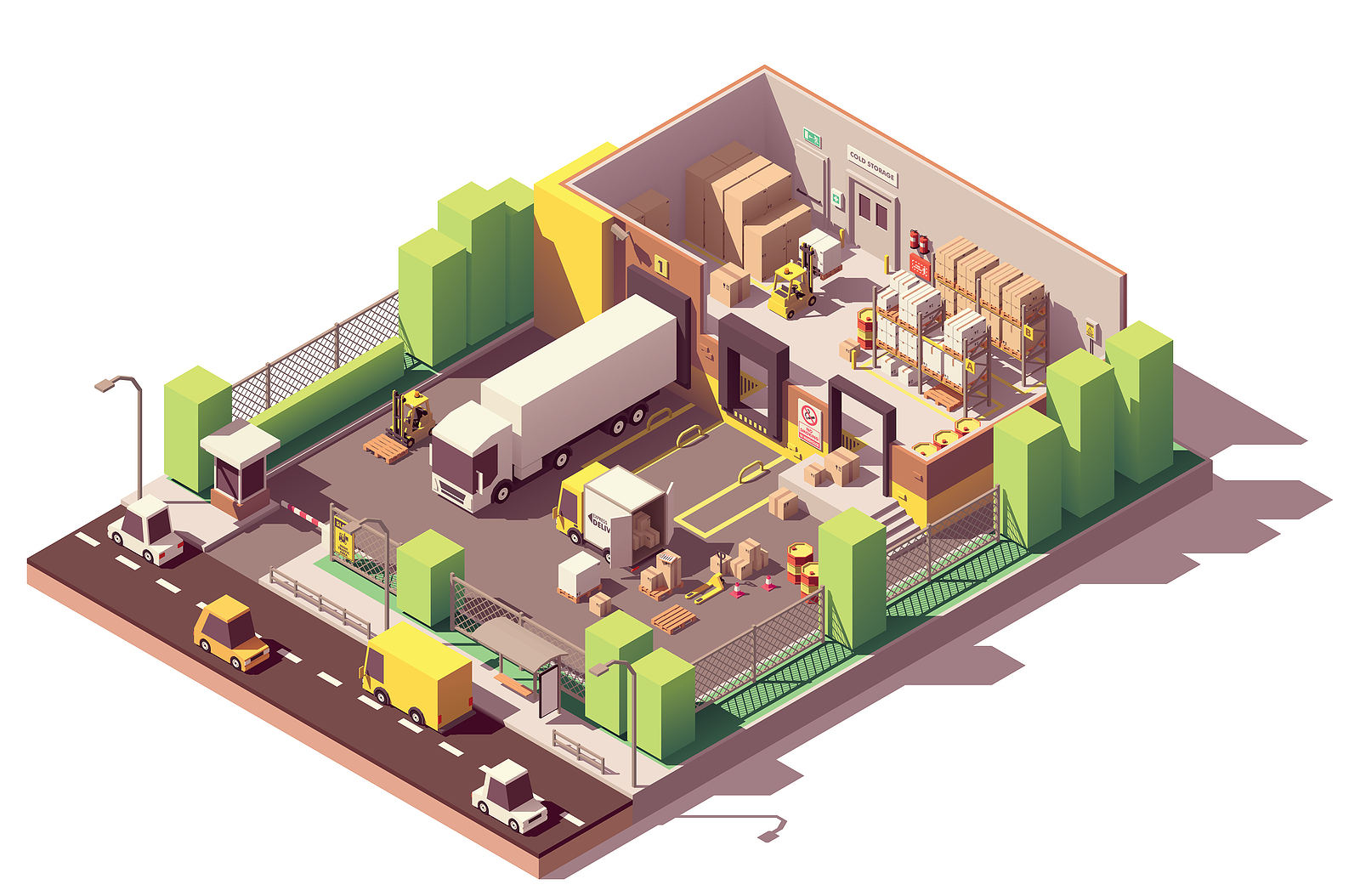
Speed is one of the biggest advantages of cross-docking, but moving freight quickly is only part of an efficient cross-dock operation. High-volume distribution centers also need organized staging areas, clear traffic patterns, accurate freight identification, coordinated inbound and outbound schedules, and enough temporary capacity to prevent backups.
In a traditional warehouse, products may be received, put away, stored, picked, and eventually shipped. Cross-docking reduces or eliminates much of that storage period. Freight arrives at an inbound dock, is sorted or prepared as necessary, and moves toward outbound transportation with little or no conventional warehousing.
That doesn’t mean every pallet moves directly from one truck to another. Freight may need to wait for an outbound trailer, be sorted by route, undergo shipment verification, be placed in loading sequence, or be temporarily held during a volume surge. That makes the cross-dock staging area one of the most important parts of a high-volume distribution operation. When staging is organized, freight keeps moving. When it isn’t, pallets accumulate, forklifts travel farther, dock doors become congested, and small delays can quickly spread throughout the operation.
Here’s how to develop a cross-dock staging strategy designed to keep freight moving.
What Is Cross-Dock Staging?
Cross-dock staging is the temporary positioning and organization of freight between receiving and outbound shipment. Instead of following a conventional warehouse flow such as:
Receive → Put Away → Store → Pick → Ship
a cross-dock facility generally aims for something closer to:
Receive → Sort/Verify → Stage → Ship
Reducing conventional storage and put-away can eliminate unnecessary handling and shorten the amount of time products spend inside a distribution center.
However, cross-docking doesn’t necessarily mean freight never touches the warehouse floor. Short-term staging may be necessary because of:
- Outbound trailer availability
- Route consolidation
- Sorting requirements
- Shipment verification
- Load sequencing
- Carrier delays
- Temporary volume surges
- Exceptions or damaged freight
The goal isn’t necessarily to eliminate staging. It’s to prevent staging from becoming uncontrolled storage.
Why Cross-Dock Staging Matters More as Volume Increases
A staging system that works at moderate volume can quickly break down during peak periods. Imagine several inbound trailers arriving within a short period. One outbound trailer is late, another isn’t ready to load, and a third shipment requires additional verification. Freight continues entering the facility even though outbound capacity has temporarily slowed. The staging area becomes the buffer. As that buffer fills, it can begin affecting:
- Dock-door availability
- Trailer dwell time
- Forklift travel
- Congestion
- Loading schedules
- Labor productivity
- On-time departures
Eventually, inbound trucks may have nowhere to unload. That’s why high-volume facilities should treat staging capacity as part of the overall freight-flow strategy rather than simply allocating whatever floor space happens to be available.
Design Cross-Dock Staging Around Freight Flow
An efficient cross-dock warehouse layout starts by understanding exactly how freight travels through the building.
Map the Inbound-to-Outbound Path
Map every step a shipment takes from arrival to departure, including:
- Receiving doors
- Inspection and verification points
- Sorting areas
- Staging lanes
- Outbound doors
- Exception areas
- Damaged-freight areas
Then look for unnecessary movement. Does freight routinely backtrack? Are forklifts crossing major traffic lanes simply to reach staging? Are loads being moved several times before reaching their outbound doors? Each unnecessary movement consumes time and labor while adding traffic to the warehouse floor.
Minimize Travel Distance
Whenever practical, stage freight near its intended outbound destination. High-volume freight flows may benefit from strategically assigned inbound and outbound doors that reduce the distance material-handling equipment must travel. The objective is straightforward: move freight forward instead of moving it around. A staging location that forces forklift operators to repeatedly cross the facility may create more problems than it solves.
Separate Inbound and Outbound Activity
Where the facility layout permits, establish clearly identifiable receiving and shipping areas. Facilities can use:
- Floor markings
- Signs
- Lane numbers
- Dock-door numbers
- Color coding
- Digital assignments
The destination of freight should be obvious to the employees handling it. Just as importantly, inbound freight shouldn’t gradually spill into areas needed to prepare outbound loads.
Build Clearly Defined Cross-Dock Staging Lanes
A pallet shouldn’t be placed somewhere simply because there happens to be an empty spot. Every load entering staging should have a defined destination.
Assign Every Load a Destination
Depending on the operation, cross-dock staging lanes might be assigned according to:
- Outbound route
- Customer
- Store
- Carrier
- Destination region
- Departure window
- Priority level
Barcode, RFID, or warehouse management system verification can provide another layer of control where those technologies are available. Whatever system is used, employees should be able to determine where freight belongs without relying solely on verbal instructions.
Establish Staging Lane Capacity Limits
A designated staging area shouldn’t be treated as having unlimited capacity simply because additional floor space exists nearby. Determine how many pallets, carts, containers, or other handling units can safely occupy each staging zone. Then establish a trigger for when a lane approaches its limit. For example, the facility might establish an overflow procedure when a staging lane reaches a predetermined percentage of its planned capacity. The exact threshold should reflect the facility’s layout, throughput, operating procedures, and safety requirements. The important part is having the response determined before the lane is full.
Keep Staging Temporary
When freight remains in staging longer than expected, determine why. Create escalation procedures for situations such as:
- Missed outbound trucks
- Delayed carriers
- Documentation problems
- Damaged freight
- Incorrect shipments
- Capacity constraints
Without those procedures, temporary staging can quietly become unofficial warehouse storage.
Stage Freight According to Outbound Loading Sequence
Where freight is staged matters. How it is arranged within staging matters too.
Make First-Out Freight the Most Accessible
Freight should be organized according to departure and loading requirements rather than simply filling every available spot. An early-departure shipment shouldn’t be buried behind freight that isn’t scheduled to leave for several more hours. Coordinate staging assignments with outbound trailer arrivals, departure windows, and appointment schedules so employees can retrieve loads without unnecessary rehandling.
Account for Trailer Loading Order
The order in which freight enters the trailer can also influence staging. Depending on the shipment, employees may need to consider:
- Stop sequence
- Weight distribution
- Freight dimensions
- Load stability
- Customer requirements
- Special handling needs
If the final pallet that needs to enter the trailer is inaccessible at the back of a staging lane, employees may have to move several other loads simply to retrieve it. Planning staging around loading sequence helps reduce those extra touches.
Prioritize Time-Sensitive Freight
Freight with narrow departure windows may require designated expedited staging areas or priority procedures. Make that priority visually obvious. Employees shouldn’t have to rely on memory or word-of-mouth to know which load needs to move first.
How to Prevent Cross-Dock Staging Bottlenecks
Congestion usually provides warning signs before an operation reaches gridlock. Watch for situations where:
- Staging lanes routinely reach capacity.
- Pallets appear outside designated areas.
- Forklift operators regularly wait for paths to clear.
- Freight gets moved several times before loading.
- Outbound doors wait for freight.
- Inbound trucks wait because there is nowhere to unload.
- Employees spend increasing amounts of time locating shipments.
These aren’t simply inconveniences. They can indicate that part of the cross-dock process is no longer keeping pace with volume.
Find the Constraint Before Adding More Floor Space
When congestion develops, more staging space isn’t automatically the answer. Determine whether the underlying problem is:
- Insufficient dock doors
- Poor appointment scheduling
- Labor shortages
- Inefficient staging-lane assignments
- Outbound carrier delays
- Inadequate staging space
- Excess inventory entering the cross-dock
If the actual problem is scheduling, for example, expanding the staging area may simply give delayed freight more room to accumulate. Additional staging capacity is most useful when capacity itself is the constraint.
Plan for Peak-Volume Warehouse Overflow
Distribution centers shouldn’t build their staging strategies exclusively around average days. Peak days matter too. Seasonal surges, promotions, supplier variability, weather disruptions, carrier delays, and unexpected demand can all cause temporary increases in freight volume. A staging plan that works perfectly during normal operations may fail quickly when several inbound loads arrive at once.
Create an Overflow Staging Plan Before You Need It
Determine where excess freight will go before primary staging areas reach capacity. Establish clear thresholds for activating the overflow plan and identify which types of freight can be moved. Avoid improvising overflow storage in:
- Forklift travel lanes
- Pedestrian paths
- Emergency exits
- Fire-protection access areas
- Dock approaches
Using operational or safety-critical space as temporary storage can turn a capacity problem into a larger traffic or safety problem.
Use Storage Trailers for Flexible Warehouse Overflow
When interior staging space is genuinely the constraint, storage trailers can provide temporary onsite warehouse capacity without requiring permanent building expansion.
A stationary storage trailer may be useful for:
- Pre-staging appropriate outbound freight
- Holding non-urgent inventory during peak periods
- Separating slower-moving goods from rapid cross-dock flow
- Temporary storage during facility reconfiguration
- Seasonal inventory
- Packaging materials
- Equipment and supplies
Moving appropriate lower-priority inventory into an onsite storage trailer can preserve valuable interior floor space for freight that needs to move rapidly through the cross-dock.
However, an overflow trailer shouldn’t simply become a place to hide congestion. If the same freight repeatedly needs to be moved outside because of an unresolved internal bottleneck, the underlying process should still be evaluated.
Create a Storage Trailer Staging Strategy
Treat an overflow storage trailer like an extension of the warehouse rather than a miscellaneous storage space.
Decide What Belongs in the Trailer
Good candidates may include:
- Non-time-sensitive inventory
- Packaging supplies
- Seasonal materials
- Overflow inventory
- Equipment and supplies
- Freight awaiting a later processing window
High-priority freight that must leave immediately may be better kept closer to its outbound door.
Position Storage Trailers for Efficient Access
Trailer placement should consider:
- Proximity to the warehouse
- Active truck approaches
- Yard traffic
- Forklift or pallet-jack access, where appropriate
- Loading and unloading requirements
- Space required for trailer delivery or pickup
The goal is to create additional capacity without introducing another bottleneck outside the building.
Organize Trailers Like Warehouse Locations
Don’t let inventory disappear simply because it moved outside. Assign each trailer a number or ID and record what has been placed inside it. Depending on the operation, you may also establish loading zones inside the trailer, maintain FIFO or another required inventory-rotation system, and track when inventory enters and leaves temporary storage. Employees should be able to answer two basic questions at any time: What is in each trailer? Where is a specific item located?
Coordinate Dock Doors, Yard Space, and Staging
The staging floor doesn’t operate independently from the docks and yard. All three should work as one system.
Match Dock-Door Assignments to Volume
Instead of treating every dock door identically, consider freight volume, destination, and travel distance when assigning doors. High-volume freight flows may benefit from shorter paths between receiving, staging, and outbound loading. Reducing a forklift trip by a small amount may seem insignificant. Multiply that difference across hundreds or thousands of pallet movements, however, and inefficient travel can consume substantial operating time.
Manage Trailer Arrival Timing
Coordinate inbound and outbound appointments to reduce excessive simultaneous arrivals. Facilities should maintain visibility into:
- Inbound ETAs
- Outbound trailer availability
- Early arrivals
- Late arrivals
- Unscheduled arrivals
Establish procedures for each exception so employees aren’t improvising every time a carrier misses its expected window.
Treat the Yard as Part of the Cross-Dock
Dropped trailers and temporary storage trailers should be incorporated into capacity planning. Maintain accurate information about each trailer’s location and status and minimize unnecessary trailer moves. An organized warehouse paired with a disorganized yard can still create delays.
Maintain Safe Cross-Dock Staging Areas
High throughput shouldn’t come at the expense of safe material handling.
Keep Aisles and Travel Paths Clear
Staging should remain inside designated staging areas. Don’t allow overflow freight to gradually consume forklift travel lanes, pedestrian routes, doorways, or other required passages. Clear traffic routes are particularly important when forklifts and other powered industrial trucks are moving frequently through staging areas.
Separate Forklifts and Pedestrians
Where possible, establish clearly identifiable forklift lanes and pedestrian routes. Facilities may also use appropriate controls such as:
- Floor markings
- Signs
- Barriers
- Mirrors
- Warning systems
Pay particular attention to blind intersections and locations where pedestrians and material-handling equipment frequently cross paths.
Maintain Loading Dock Safety
Keep dock surfaces clear and maintain visibility around dock edges. Appropriate procedures should also be in place for dockboards and for preventing trailers from moving unexpectedly during loading and unloading. Regularly inspect high-traffic dock and staging areas rather than waiting until the end of a shift to identify problems.
Make Housekeeping Part of Every Shift
Plastic wrap, broken pallets, straps, cardboard, and other debris can quickly accumulate in a busy cross-dock. Build housekeeping into normal operations. Clean spills promptly, remove debris, and inspect staging zones periodically throughout high-volume shifts. Good housekeeping isn’t simply about appearance. Keeping floors and travel paths clear helps the operation continue moving safely and efficiently.
Use Visual Management to Keep Freight Moving
Employees should be able to look across the staging floor and understand what’s happening. Depending on the facility, visual management strategies can include:
- Color-coded staging lanes
- Consistently numbered doors and lanes
- Floor markings showing staging boundaries
- Displays showing outbound departure times
- Visible identifiers for priority or exception freight
- WMS alerts for staging lanes approaching capacity
The easier it is to see where freight belongs and where congestion is developing, the faster supervisors can respond.
Cross-Dock Metrics Worth Tracking
You can’t improve cross-dock efficiency if you don’t know where time and capacity are being lost. Consider tracking these cross-dock KPIs.
Dock-to-Dock Dwell Time
How long does freight remain in the facility between receiving and outbound movement? Tracking dwell can help identify loads, routes, or periods when freight spends too much time waiting.
Trailer Turn Time
How long do inbound and outbound trailers occupy dock doors? Long turn times may reduce available dock capacity and contribute to congestion elsewhere in the facility.
Freight Touches
How many times is a pallet or load handled between receiving and outbound shipment? Repeated rehandling may indicate problems with staging assignments, loading sequence, or outbound coordination.
Staging Lane Utilization
Which staging areas routinely approach or exceed planned capacity? Repeated problems in the same lanes may reveal a mismatch between allocated space and actual freight volume.
Misroutes and Rehandling
How often does freight need to be moved because it was initially staged in the wrong location? A high rate can point to problems with labeling, scanning, lane assignments, or employee processes.
On-Time Outbound Departures
Are staging, dock, or labor constraints contributing to late departures? Tracking the causes of missed schedules can help distinguish a staging problem from a carrier, labor, or scheduling problem.
Forklift Travel Distance
Are operators traveling farther than necessary between receiving, staging, and shipping? Changes to lane and dock assignments may reduce unnecessary travel without adding floor space.
Cross-Dock Staging Checklist
Use this checklist to evaluate your current distribution center staging strategy:
☐ Map inbound-to-outbound freight flow.
☐ Establish designated staging lanes.
☐ Give each lane a clear purpose or destination.
☐ Set capacity limits for staging areas.
☐ Keep forklift and pedestrian routes unobstructed.
☐ Stage freight according to outbound sequence.
☐ Establish procedures for exception freight.
☐ Monitor freight dwell time.
☐ Coordinate inbound and outbound appointments.
☐ Establish predetermined overflow triggers.
☐ Identify safe overflow storage locations.
☐ Consider onsite storage trailers for appropriate overflow inventory.
☐ Track inventory moved into temporary storage trailers.
☐ Monitor dock and staging KPIs.
☐ Reassess the staging layout as freight volume changes.
Frequently Asked Questions About Cross-Dock Staging
What is a cross-dock staging area?
A cross-dock staging area is temporary space used to organize freight between receiving and outbound loading. Freight may be staged while it is sorted, verified, consolidated, sequenced, or waiting for an outbound trailer. The objective is generally to keep this period brief so staging facilitates freight movement rather than becoming long-term storage.
How long should freight remain in cross-dock staging?
There isn’t a universal maximum amount of time that applies to every cross-dock operation. The appropriate dwell time depends on the facility’s operating model, schedules, freight, and customer requirements. In general, cross-dock operations are designed to minimize storage and unnecessary dwell. Freight that routinely remains in staging longer than planned should be investigated to determine what’s causing the delay.
How much cross-dock staging space does a distribution center need?
The amount of staging space required depends on factors such as:
- Peak throughput
- Pallet or load dimensions
- Inbound arrival patterns
- Outbound departure schedules
- Number of dock doors
- Trailer availability
- Amount of freight requiring temporary holding
Plan around peak operating conditions rather than assuming average daily volume represents the facility’s maximum staging requirement.
How can a distribution center reduce cross-dock congestion?
Start by identifying the source of the congestion. Better appointment scheduling, clearer staging-lane assignments, shorter travel paths, visual controls, improved exception processes, and planned overflow capacity can all help in the appropriate circumstances. If the bottleneck isn’t staging capacity itself, simply creating more staging space may not resolve the problem.
Can storage trailers be used for warehouse overflow?
Yes. Storage trailers can provide temporary onsite warehouse overflow space for appropriate inventory, materials, equipment, and supplies. Moving slower-moving or non-urgent inventory into temporary onsite storage can help preserve interior staging space for high-velocity freight during peak periods, seasonal surges, facility projects, or other temporary capacity constraints.
What’s the difference between a storage trailer and a cross-dock trailer?
The distinction often comes down to how the trailer is being used. A trailer participating directly in the inbound or outbound movement of freight may be part of the cross-dock transportation process. A stationary storage trailer is primarily being used to provide temporary onsite storage capacity.
What should never be used as overflow staging space?
Avoid using areas where stored freight could interfere with safe movement, emergency access, or normal operations. Examples include forklift travel lanes, designated pedestrian routes, emergency exits, fire-protection access areas, and active dock approaches. Overflow locations should be identified as part of the facility’s capacity plan rather than improvised after primary staging areas are already full.
Create More Staging Capacity Without Expanding the Warehouse
An efficient cross-dock operation depends on keeping high-velocity freight moving. When staging lanes become filled with seasonal inventory, supplies, equipment, or other materials that don’t need to occupy valuable interior floor space, the entire operation can become less efficient.
For temporary or seasonal capacity constraints, onsite storage trailers can provide additional warehouse overflow storage without requiring permanent building expansion. They can be used to hold appropriate overflow inventory, packaging materials, equipment, supplies, and other goods while keeping valuable interior staging areas available for freight that needs to move quickly.
Storage On-Site provides storage trailers for Indianapolis-area warehouses, distribution centers, manufacturers, and other commercial operations. With multiple trailer sizes available, businesses can add temporary onsite capacity during peak seasons, facility projects, inventory surges, and other periods when existing warehouse space isn’t enough.
Contact Storage On-Site or call 317-358-0380 to discuss storage trailer availability and find an onsite storage solution for your facility.